

Learning how to choose a blog niche is one of the most important decisions you’ll make when starting a blog.
Your niche influences what you write about, who you attract, which problems you solve, and how your blog can eventually make money.
However, many beginners approach this decision from the wrong direction.
A quick search for “profitable blog niches” often produces hundreds of lists. It can be tempting to pick one of those topics simply because someone else says it makes money.
The problem is that profitability alone doesn’t make a niche a good fit.
A topic can have plenty of commercial activity while still leaving you with no clear audience, weak positioning, or limited motivation to keep creating content.
Instead, think about your niche as the foundation of your blog-to-business system.
A useful niche should give you four things:
- A specific audience to understand
- Recurring problems to solve
- Enough content opportunities to stay useful
- A realistic path toward a business
So, the goal isn’t simply to find a “profitable niche.”
What you’re really looking for is a niche where your audience has problems you can help solve in a useful and sustainable way.
In Day 1 of this series, we looked at the bigger picture of how to start a blog in 2026.
If you haven’t read it yet, start here:
Day 1 — How to Start a Blog in 2026: The Simple Way
Now let’s look at how to choose a blog niche that can support both your content and your business.
What Is a Blog Niche, Really?
A blog niche is simply the specific area your blog focuses on.
That definition, however, is too broad to be very useful.
For instance, “health” is a topic.
“Fitness” is a topic.
“Personal finance” is another topic.
“Travel” is a topic as well.
None of these categories tells you exactly who the blog is for or which problem you’re trying to solve.
A stronger niche becomes more specific.
Consider these examples:
- Fitness for busy professionals
- Personal finance for freelancers
- Travel planning for first-time solo travelers
- Productivity for remote workers
- WordPress tutorials for creators building small businesses
Notice the difference.
Instead of speaking to an enormous market, you’re focusing on a particular group of people with particular needs.
That focus makes content much easier to plan.
More importantly, it gives you something you can eventually build a business around.
A useful way to think about this is:
Niche = Audience + Problem + Angle
The audience tells you who you’re helping.
The problem tells you what they need.
Your angle explains why people should pay attention to your content.
Together, those three elements create a much stronger foundation than simply choosing a popular category.
Don’t Start With “What’s Profitable?”
One of the most common mistakes is starting with this question:
What’s the most profitable blog niche?
At first, that sounds like the right question.
After all, you’re building a business, so profitability matters.
Still, money shouldn’t be the only factor.
A niche can have expensive products, strong advertising demand, and successful companies while being a poor fit for your own blog.
Before choosing it, ask yourself:
- Do I understand the audience?
- Do I understand their problems?
- Can I create genuinely useful content?
- Can I bring a useful perspective?
- Can I stay interested long enough to build authority?
- Can the niche support a business beyond advertising?
These questions matter because blogging is not a one-week project.
Creating dozens or even hundreds of useful pieces of content can take time.
For that reason, your niche needs enough depth to support the work.
A better question is:
Where do audience, problems, content opportunities, and business potential overlap?
That intersection is where a strong niche often begins.
How to Choose a Blog Niche: The 5-Part Niche Test
Before committing to a niche, run it through five simple questions.
1. Is There a Specific Audience?
Start with a basic question:
Who exactly is this blog for?
An answer such as “everyone interested in fitness” is probably too broad.
A more focused version could be:
“Busy professionals who want simple home workouts.”
Now the audience is much clearer.
You can think about their schedules, frustrations, goals, questions, and buying behavior.
That clarity also makes content easier to create.
Instead of writing:
“10 Benefits of Exercise”
you could create:
“10-Minute Home Workouts for Busy Professionals”
The second topic speaks directly to a defined group of people.
It also gives you a clearer foundation for future content.
Over time, the same audience could potentially buy your products, join your email list, use your recommendations, or hire you for a service.
So don’t just choose a topic.
Choose a person.
How to Choose a Blog Niche Around Real Problems
2. Does This Audience Have Recurring Problems?
Once the audience is clear, look at the problems they repeatedly experience.
This is where the business potential of a niche starts becoming easier to understand.
People rarely search for information simply because they want “content.”
Usually, they have a problem.
Perhaps they want to learn something.
Maybe they’re trying to save time.
Sometimes they want to avoid an expensive mistake.
In other cases, they’re working toward a specific outcome.
Consider a freelancer.
Common problems might include:
- Finding clients
- Creating proposals
- Managing projects
- Setting prices
- Organizing finances
- Building a personal brand
Every one of those problems can become a content opportunity.
Some can also become product opportunities.
Possible solutions include:
- Templates
- Checklists
- Guides
- Courses
- Tools
- Services
- Memberships
That creates a natural connection between content and business.
The strongest niches often contain problems that don’t disappear after someone reads one article.
Instead, related problems continue to appear as people move forward.
That ongoing demand gives your blog room to grow.
Can You Create Enough Content for Your Blog Niche?
3. Can You Create Enough Useful Content?
A niche might sound interesting at first.
The next question is whether you can realistically create useful content about it for years.
You don’t need 1,000 article ideas on day one.
What matters is having enough depth to help the same audience from different angles.
One useful exercise is to break the niche into content clusters.
Imagine your niche is:
WordPress for creators
Possible content areas could include:
- Starting a WordPress website
- Choosing a theme
- Website design
- Performance
- SEO
- Email marketing
- Digital products
- Landing pages
- Content strategy
- Monetization
Suddenly, one focused niche contains many connected topics.
That’s a positive signal.
By contrast, a niche that produces only five or six meaningful article ideas may be too narrow.
Recurring questions can help you discover additional opportunities.
What do beginners ask?
Where do intermediate users struggle?
Which mistakes happen repeatedly?
What tools do people compare?
Which decisions require more explanation?
Those questions can eventually become the foundation of your content system.
How to Choose a Blog Niche With a Useful Angle
4. Can You Bring a Useful Angle?
This is the part many niche lists ignore.
Ask yourself:
Why am I qualified to create something useful here?
Professional experience can provide a strong starting point.
Years of using particular tools can also give you practical knowledge.
Perhaps you’ve solved the problem yourself.
A different perspective may help you approach it in a more useful way.
Sometimes, the advantage is simply being able to explain something more clearly.
You don’t have to be the world’s leading expert.
At the same time, there should be a credible reason for you to contribute.
That reason might come from experience.
It could come from research or experimentation.
Your advantage might also come from working with a specific type of audience.
Even a clearer teaching style can become a useful angle.
For example, hundreds of websites already cover WordPress.
That doesn’t mean there’s no room for another WordPress blog.
Your positioning could be:
“I help non-technical creators build simple WordPress websites without unnecessary complexity.”
Now the audience is clearer.
The promise is clearer too.
You’re no longer trying to compete with every WordPress website.
Instead, you’re speaking directly to a particular group of people.
That distinction can make your content strategy much easier to build.
Can Your Blog Niche Connect to a Business?
5. Can This Niche Connect to a Business?
Finally, consider a question that many bloggers leave until much later:
What could this blog eventually sell?
You don’t need a product today.
However, having at least one realistic business model in mind can help you evaluate the niche.
Depending on the market, possibilities might include:
- Digital products
- Affiliate recommendations
- Services
- Consulting
- Courses
- Templates
- Software
- Memberships
- Sponsorships
- Physical products
The important point is not to choose the business model first.
Start with the audience and their problems.
Then consider what kind of solution they might eventually pay for.
For example:
Audience: Freelancers
Problem: They struggle to organize client projects.
Content: Tutorials, workflows, checklists, and productivity guides.
Product: A client project management template.
That’s a simple connection between content and business.
A huge audience isn’t necessary to test an idea like this.
The more important question is whether the audience has a meaningful problem and whether your solution is useful.
A Simple Formula for Choosing a Blog Niche
The whole process can be simplified into one framework:
Broad Market → Specific Audience → Recurring Problem → Your Angle → Content Opportunities → Business Opportunity
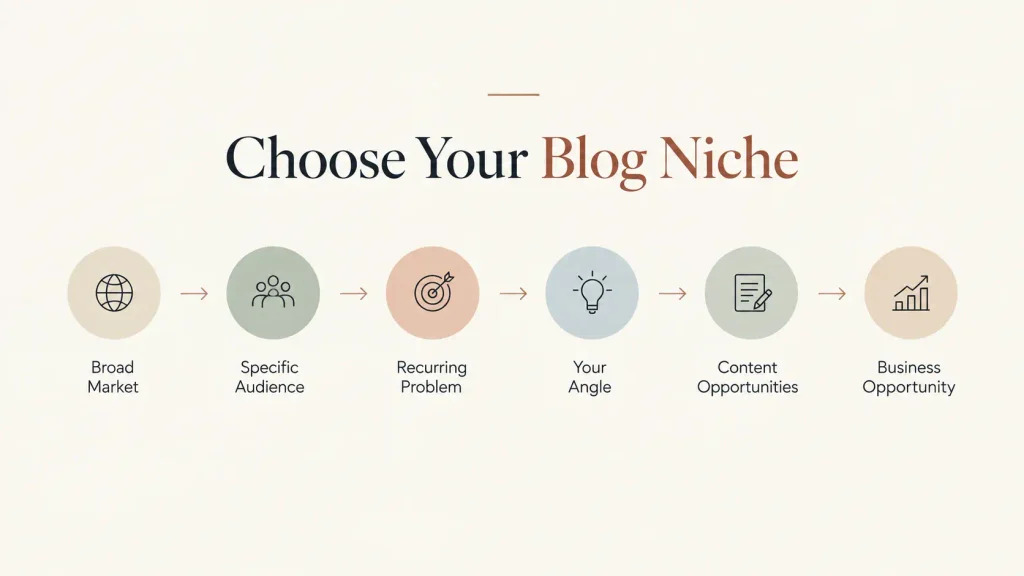
Let’s break that down.
Broad Market
Start with a broad area you understand.
Examples include:
- Fitness
- Finance
- Technology
- Education
- Travel
- Food
- Business
- Personal development
Specific Audience
Next, narrow down the people you want to help.
For example:
Finance → Personal finance for freelancers
That change immediately gives the topic more direction.
Recurring Problem
Now identify a problem that audience experiences repeatedly.
For example:
Freelancers struggle to manage irregular income.
The problem is specific enough to create useful content around.
Your Angle
Next, decide how you want to approach the problem.
Perhaps your angle is:
Simple financial systems for freelancers who hate complicated spreadsheets.
Now your positioning is much more distinctive.
Content Opportunities
From there, you can develop questions such as:
- How to budget with irregular income
- How much freelancers should save for taxes
- How to create a simple freelancer budget
- How to separate business and personal finances
- How to build an emergency fund with variable income
Each question can become an article, video, email, template, or another piece of useful content.
Business Opportunity
Finally, consider what could solve the problem more deeply.
Possible options include:
- A budgeting template
- A financial planning guide
- A course
- A service
- An affiliate recommendation
Now the niche has a clear connection between audience, content, and business.
That’s much stronger than simply saying:
“I want to start a personal finance blog.”
How to Validate a Blog Niche Before You Commit
You don’t have to guess whether a niche has potential.
Instead, look for evidence.
The goal isn’t to prove that your niche will definitely succeed.
You’re simply looking for signs that people care about the problems you’re considering.
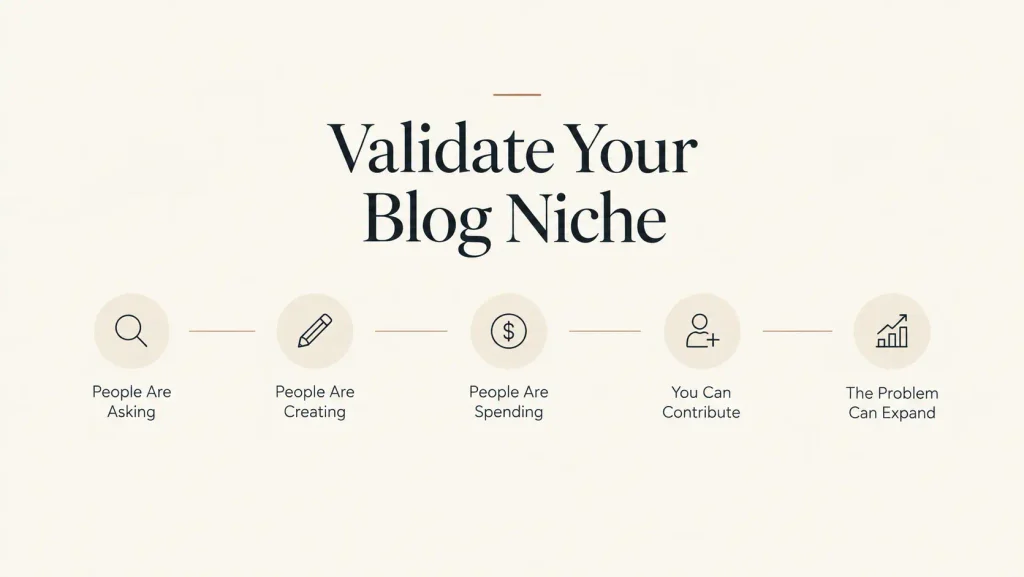
Signal 1: People Are Asking
Start by searching for questions related to your niche.
Useful places include:
- YouTube
- Forums
- Facebook groups
- Community discussions
- Blog comments
- Product reviews
Pay attention to repeated questions.
When people ask similar questions again and again, that’s useful information.
It suggests the problem is important enough for people to spend time trying to solve it.
For search trends, Google Trends can also help you compare interest in topics over time. Use it as a research signal rather than as proof that a niche will succeed.
Signal 2: People Are Creating
Next, examine the existing content around the topic.
Look for:
- Blogs
- YouTube channels
- Podcasts
- Newsletters
- Courses
- Books
- Communities
Competition isn’t automatically a bad thing.
In fact, a completely empty market can sometimes mean there isn’t much demand.
The more useful question is:
What is missing from the existing content?
Perhaps explanations are too complicated.
Maybe beginner questions aren’t answered well.
Another possibility is that existing content is outdated or overly generic.
Those gaps can become opportunities for your own content.
Signal 3: People Are Spending
Now look for commercial signals.
Are people already buying:
- Software?
- Courses?
- Templates?
- Services?
- Books?
- Coaching?
- Tools?
- Products?
Existing spending doesn’t guarantee that your blog will make money.
It does, however, show that people are already spending money around the problems in that market.
That’s valuable information when evaluating a niche.
Signal 4: You Can Contribute
Your own experience matters here.
Professional experience can give you useful context.
Personal experience can help you understand a problem from the customer’s perspective.
Practical experimentation can produce original insights.
You might also understand a particular audience or industry better than a generalist creator.
The key question is not:
“Am I famous enough?”
Instead, ask:
“Can I create something genuinely useful for this audience?”
If the answer is yes, you have a reasonable starting point.
Signal 5: The Problem Can Expand
Finally, think beyond your first few articles.
Can one problem lead to related questions?
Can those questions create different types of content?
Could your audience eventually need more advanced solutions?
For example, someone learning how to start freelancing may later need help with:
- Pricing
- Client acquisition
- Contracts
- Project management
- Taxes
- Marketing
- Productivity
- Hiring
One initial problem can therefore lead to an entire ecosystem of content and products.
That’s exactly the kind of depth you want to find.
Don’t Ignore Trends, But Don’t Chase Them Either
Trends can create opportunities.
Building an entire blog around a short-lived trend, however, can make the business less durable.
A better approach is to look for the intersection between:
Long-term demand + emerging opportunities
Technology is a good example.
Tools change quickly, but many underlying problems remain.
People still want to:
- Save time
- Make money
- Learn skills
- Solve problems
- Communicate better
- Build businesses
- Improve their health
- Make better decisions
The tools may change.
The underlying needs often remain.
That gives a niche more room to evolve as the market changes.
Use a Blog Niche Scorecard
If you’re deciding between several niches, a simple scorecard can make the comparison easier.
Rate each niche from 1 to 5 on these questions:
| Question | Score |
|---|---|
| Do I understand this audience? | /5 |
| Does this audience have recurring problems? | /5 |
| Can I create useful content for a long time? | /5 |
| Can I bring a useful angle? | /5 |
| Are people already spending money around these problems? | /5 |
| Can this niche support more than one business model? | /5 |
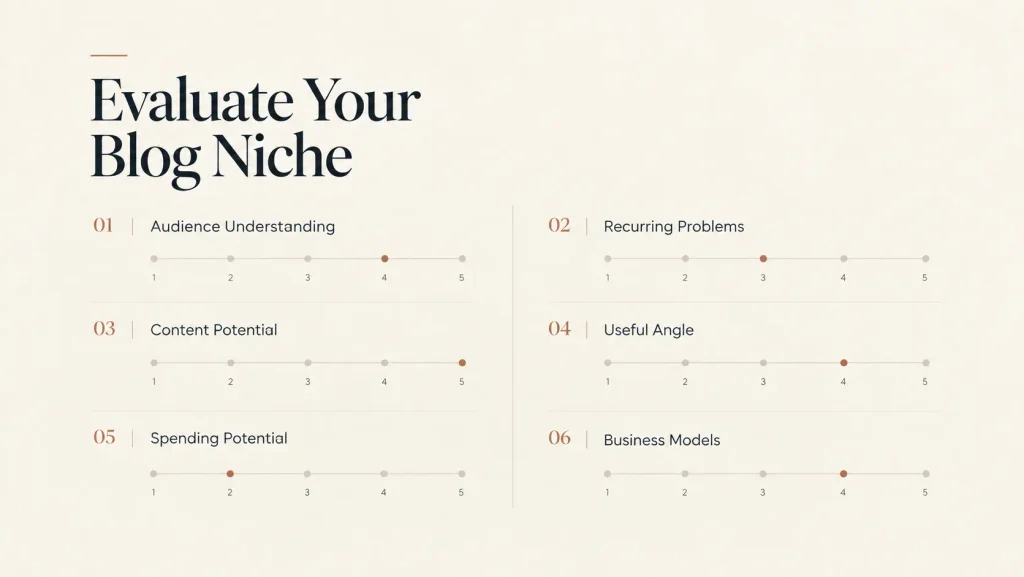
The purpose isn’t to predict success.
Instead, the scorecard highlights weak assumptions.
For instance, you may discover that you love a particular topic but don’t understand the audience very well.
Another niche might have a clear audience but limited business opportunities.
That information is useful.
You can investigate those gaps before committing to a direction.
Watch Out for These “Profitable Niche” Traps
Some niches look attractive because they have obvious commercial activity.
Even so, commercial activity alone doesn’t make them suitable for your blog.
Trap 1: Choosing a Niche Only Because It Makes Money
If you have no interest or experience in the topic, content creation can become exhausting.
Developing a unique perspective may also become difficult.
Trap 2: Going Too Broad
“Business” is too broad.
“Technology” is too broad.
“Health” is too broad.
A narrower starting point usually makes positioning easier.
You can always expand later as you understand the audience better.
Trap 3: Going So Narrow That There Is No Room to Grow
The opposite problem exists too.
An extremely specific niche may eventually run out of meaningful topics or potential products.
Look for a focused starting point with enough room to expand.
Trap 4: Copying Someone Else’s Niche
Another blogger’s niche might work perfectly for them.
Their audience, expertise, distribution, brand, products, and experience may be completely different from yours.
Use successful blogs as research.
Don’t copy their business model without understanding why it works.
Trap 5: Confusing Traffic With Business Potential
A topic can generate a lot of traffic while still having weak monetization opportunities.
Some informational or entertainment topics attract large audiences but don’t have many obvious products or services connected to them.
For that reason, consider both:
Audience size and audience value.
Millions of visitors aren’t necessarily required.
A smaller audience with a meaningful problem can sometimes create a much clearer business opportunity.
A 30-Minute Blog Niche Exercise
If you’re still unsure how to choose a blog niche, don’t spend another week thinking about it.
Try this simple exercise instead.
First 10 Minutes: List Your Knowledge
Write down five topics you know something about.
Don’t overthink the list.
Include:
- Things you’ve done professionally
- Problems you’ve solved
- Tools you’ve used
- Skills you’ve developed
- Hobbies you’ve spent years learning
- Industries you’ve worked in
The goal is simply to identify areas where you already have some useful context.
Next 10 Minutes: Identify the Audience and Problems
For each topic, write down:
- Who could benefit from this knowledge?
- What problems do they have?
- What questions do they ask?
- What mistakes do they make?
- What would they pay to solve?
Perfect answers aren’t necessary at this stage.
Look for patterns instead.
Final 10 Minutes: Validate the Top Ideas
Choose your top two or three ideas.
Then research them.
Look at Google, YouTube, Reddit, blogs, communities, products, software, and services.
Try to answer five questions:
- Are people asking?
- Are people creating?
- Are people spending?
- Can I contribute?
- Can the problem expand?
At the end of 30 minutes, you should have enough information to choose a niche to test.
That doesn’t mean you’ve chosen a niche for life.
You’ve simply found a promising direction worth exploring.
Your Niche Isn’t a Life Sentence
This is important.
You don’t need to choose the perfect niche.
You need to choose a good starting point.
As content goes live, you’ll learn more about:
- What people respond to
- What questions they ask
- What content performs well
- What problems they care about
- What products they want
- What you enjoy creating
Your niche can become clearer over time.
A useful process looks like this:
Publish → Listen → Learn → Improve
That’s more realistic than expecting yourself to make a perfect decision before publishing your first article.
A focused niche can also expand gradually.
For example:
WordPress for creators
could eventually become:
WordPress + content systems + creator business
The direction can emerge from what your audience actually needs.
What I Would Do If I Were Starting From Zero
If I were starting a new blog today, I wouldn’t spend months trying to discover the perfect niche.
I’d begin with a topic where I have some knowledge or genuine interest.
From there, I’d identify a specific audience.
Next, I’d write down their recurring problems.
After that, I’d study existing content and products in the market.
I’d also look for gaps.
Which questions aren’t being answered well?
Where are explanations too complicated?
What practical information is missing?
Which lessons could I explain from direct experience?
Once those patterns became clearer, I’d choose one focused niche and start publishing.
Most importantly, I’d treat the first few months as a learning period.
The goal wouldn’t be to prove that I chose the perfect niche.
Instead, I’d use the early content to learn whether the audience responds.
That distinction removes a lot of unnecessary pressure.
Your Niche Makes the Next Decisions Easier
Once your niche is clear, many other decisions become simpler.
The niche can help determine:
- What content to create
- What keywords to target
- What products to recommend
- What email subscribers need
- What digital products to create
- What services to offer
- What communities to join
- What partnerships make sense
Without a clear niche, these decisions can feel disconnected.
With a focused audience, they begin to fit together.
That’s why niche selection isn’t just an SEO decision.
It’s a business decision.
From Niche to Business Model
Now we can connect this back to the bigger framework from Day 1.
Remember:
Audience → Problem → Content → Relationship → Product → Business
Your niche helps define the first two pieces.
The audience tells you who you’re helping.
The problem tells you what they need.
Useful content demonstrates that you understand those problems.
An email list gives you a direct relationship with the audience.
A product provides a deeper solution.
The business then grows around the solutions you can provide.
That’s why I wouldn’t start with:
“How can I make money from blogging?”
I’d start with:
“Who can I help, and what problem can I solve?”
Once those answers become clearer, the monetization strategy becomes much easier to design.
Final Thoughts on How to Choose a Blog Niche
Choosing a blog niche that can actually make money isn’t about finding a magic topic.
Instead, it’s about finding the overlap between:
Audience + Problem + Content + Your Angle + Business Opportunity
A strong niche gives you someone to help.
It gives you problems to solve.
It gives you content ideas.
It gives you a reason to build trust.
Eventually, it can also give you something to build a business around.
You don’t need to predict the future.
You don’t need to find the “perfect” niche.
Choose a focused audience, identify a real problem, validate the opportunity, and start learning from the market.
The goal isn’t to build a blog around a random topic.
It’s to build a useful platform around a specific group of people.
Once you know who you’re helping and what problem you’re solving, the next question becomes much more interesting:
How should the blog actually make money?
That’s what we’ll tackle next.
Continue the Series
Day 1 — How to Start a Blog in 2026: The Simple Way
Day 2 — How to Choose a Blog Niche That Can Actually Make Money ← You are here
Day 3 — Why Your Blog Needs a Business Model From Day One
Day 4 — How to Set Up a WordPress Blog From Scratch in 2026
Day 5 — How I’d Use AI to Build a Blog in 2026
Day 6 — Why Your Email List Is More Valuable Than Your Traffic
Day 7 — How to Create Your First $19 Digital Product
Day 8 — The Simple Blog-to-Business Funnel I’d Build in 2026
The blog is the platform.
The niche gives it direction.
The business model gives it a destination.


How to Start a Blog in 2026: The Simple Way | AZ Theme
[…] Day 2 — How to Choose a Blog Niche That Can Actually Make Money […]
Blog Business Model: Why Your Blog Needs One From Day One
[…] [Day 2], we narrowed that down by choosing a focused […]
How to Set Up a WordPress Blog in 2026: A Simple Guide
[…] Day 2: How to Choose a Blog Niche That Can Actually Make Money […]