

If you’re wondering how to start a blog in 2026, the technical setup is only the beginning.
Buying a domain, choosing a WordPress theme, installing plugins, and publishing your first article are all relatively easy.
The harder question is:
What are you actually building?
A blog can be a personal project, a media site, a source of affiliate income, a way to attract clients, or the foundation of a much larger online business.
If you decide that part first, everything else becomes easier.
Instead of thinking:
Blog → Traffic → Ads → Money
I would build around a different system:
Audience → Problem → Content → Relationship → Product → Business
That’s the simple approach I would take if I were starting a blog from zero today.
The 5-Step Blogging Framework
Before you worry about themes, plugins, SEO tools, or social media, start with five decisions:
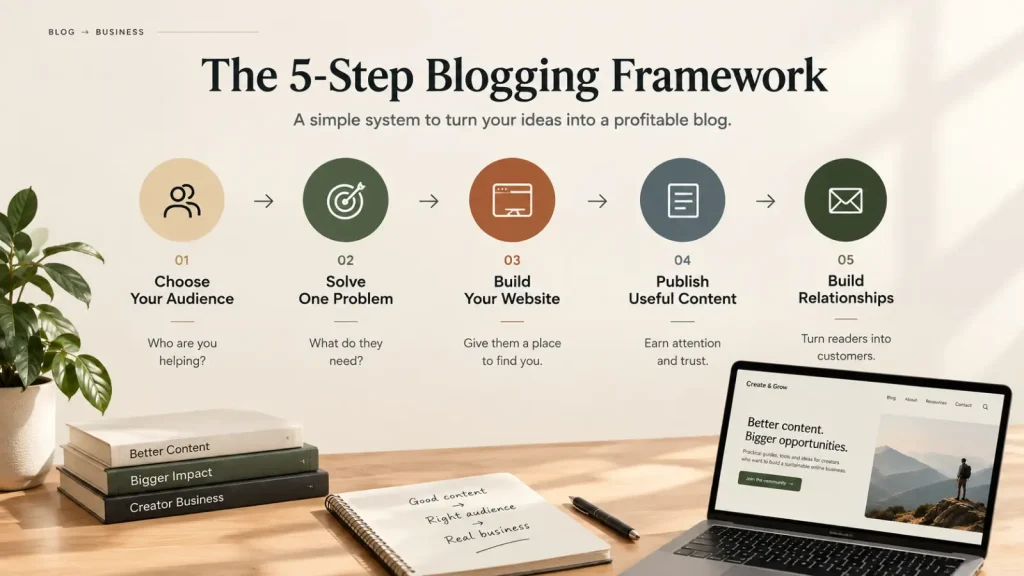
- Choose one audience.
- Solve one recurring problem.
- Build a simple website.
- Publish useful content.
- Turn readers into subscribers and customers.
The important thing is that these steps are connected.
You choose an audience so you know who you’re helping.
You identify a problem so you know what to help them with.
You build a website to give that audience a place to find your content.
You publish useful content to earn attention and trust.
Then you build a relationship with your readers and eventually create products or services that solve bigger problems.
So let’s start with the part that most beginners skip.
Start With a Person, Not a Website
When people decide to start a blog, they often begin with the website.
They search for themes.
They compare hosting plans.
They design a homepage.
They install plugins.
They spend hours choosing colors and fonts.
And sometimes, weeks later, they still don’t know exactly who the website is for.
I would do the opposite.
Start by imagining one specific person you want to help.
For example:
A beginner who wants to build a blog but feels overwhelmed by WordPress, SEO, content creation, AI, and monetization.
Now ask:
- What are they trying to accomplish?
- What are they struggling with?
- What questions do they repeatedly ask?
- What information are they missing?
- What would make their next step easier?
These questions are more important than your homepage design.
Because once you understand the person, you can make better decisions about your niche, content, website, email list, and products.
Choose a Blog Niche With a Simple Test
After identifying your audience, the next question is what your blog should focus on.
You don’t need to find the perfect niche.
You need to find a topic where your audience, their problems, and your ability to help intersect.
I would test a potential niche with three questions.
Do You Understand the Audience?
You don’t need to be the world’s leading expert.
But you should understand the people you’re trying to help.
You should be able to recognize:
- their goals
- their frustrations
- their questions
- their language
- the obstacles they face
Your own experience can be a useful starting point.
If you’ve already solved a problem yourself, you may be able to explain the path more clearly to someone who is still struggling with it.
Does the Audience Have Recurring Problems?
A good blog topic shouldn’t give you only one or two article ideas.
Look for a problem that naturally creates many related questions.
For example, someone who wants to start a blog may also need help with:
- choosing a niche
- WordPress
- content planning
- SEO
- AI tools
- email marketing
- affiliate marketing
- digital products
One problem can create an entire ecosystem of useful content.
Can You Eventually Sell Something Useful?
You don’t need a product today.
But ask yourself:
If I help this audience for the next two years, what could I eventually create that would make their lives easier?
That might be:
- a service
- a template
- a toolkit
- a course
- software
- consulting
- a physical product
You’re not trying to sell anything immediately.
You’re simply checking whether the niche has room to grow beyond advertising.
Build a Simple Blog Website in 2026
Once your audience and direction are clearer, it’s time to build the website.
But keep the first version simple.
Your first blog doesn’t need to look like a large media company.
It needs to make three things easy:
Understand → Explore → Take the next step
A new visitor should quickly understand:
- What is this website about?
- Who is it for?
- What can I learn here?
- What should I do next?
What Your First Website Actually Needs
At the beginning, you can keep the structure simple:
- Homepage
- About
- Blog
- Contact
- Email signup
You can add more pages as the business develops.
The important thing is to avoid spending weeks building features that nobody has asked for yet.
Your website is the foundation for your content and business, not the product itself.
We’ll cover the technical side—domain, hosting, WordPress installation, theme setup, plugins, and essential settings—in a separate step-by-step guide.
For now, remember one principle:
Build the smallest website that can support the business you’re trying to create.
Build a Content System, Not a List of Random Articles
Now you know who you’re helping and what your website is supposed to do.
The next challenge is content.
This is where many new blogs lose direction.
They publish one article about SEO, another about productivity, three posts about AI, a random product review, and then something completely unrelated.
Each article may be useful.
But together, the blog doesn’t feel like it is building toward anything.
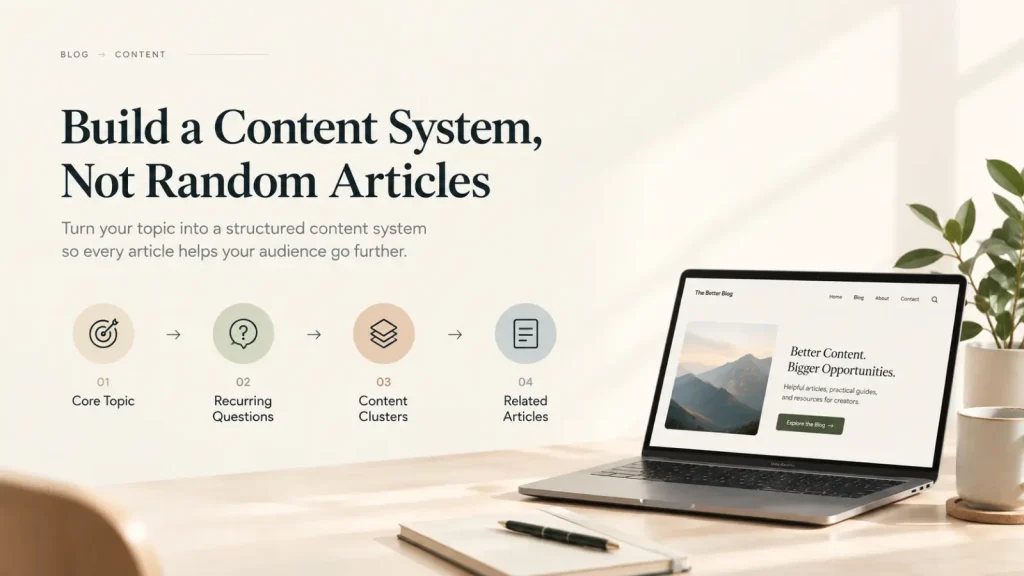
Instead, create a content system.
A simple process looks like this:
Step 1: Choose One Core Topic
Start with the main problem your blog wants to help solve.
For example:
Build a profitable blog.
Step 2: List Recurring Questions
Write down 5–10 questions your audience naturally has around that topic.
For example:
- How do I choose a niche?
- How do I start a WordPress blog?
- How do I create content?
- How can AI help me?
- How do I build an email list?
- How can I make money from a blog?
Step 3: Group Similar Questions
Turn related questions into content clusters.
For example:
- Starting a Blog
- Content Creation
- AI for Creators
- Blog Monetization
- Creator Business
Step 4: Turn Clusters Into a Series
Instead of publishing random articles, create connected content.
One article introduces the problem.
Another explains a specific solution.
Another goes deeper into implementation.
Another introduces a tool or product that helps.
Now your content starts working as a system.
You’re not simply publishing more.
You’re building a library that helps the same audience solve more of their problems.
Write for One Person
Your content strategy tells you what to write.
Your reader tells you how to write it.
When you create an article, imagine you’re helping one person who has a specific problem right now.
Instead of writing:
Blogging is an effective way to build an online presence.
You could write:
If you’ve spent two weeks choosing a WordPress theme but still haven’t published your first article, you may be solving the wrong problem.
The second version immediately speaks to a situation the reader recognizes.
For every article, ask:
- What does this person already know?
- What are they confused about?
- What mistake might they make?
- What practical next step can I give them?
This is one of the simplest ways to make beginner content more useful.
Use AI as a Tool, Not Your Author
Once your content system is clear, AI can help you work much faster.
But I wouldn’t use AI to generate hundreds of generic articles.
I’d use it to amplify your own experience and thinking.
A practical workflow looks like this:
Your Experience → AI Research → AI Outline → Your Examples + Opinions → AI Editing → Fact-Check → Publish → Repurpose

AI can help with:
- research
- organizing ideas
- creating outlines
- identifying missing sections
- improving clarity
- generating content variations
- repurposing articles
- turning articles into email or social content
But your experience, examples, judgment, and point of view are still what make the content valuable.
AI should make your thinking faster, not replace it.
We’ll go much deeper into this workflow later in the series.
Build Your Email List From the Beginning
Once you start publishing useful content, you have another challenge:
A reader can discover your article today and disappear tomorrow.
You don’t own search rankings.
You don’t control social media algorithms.
But when someone chooses to join your email list, you have a direct way to communicate with them.
That’s why I’d start building an email list early.
You don’t need a complicated funnel.
Start with one useful free resource.
For example:
Free Blogger Business Starter Kit
It could contain:
- Blog launch checklist
- Content planning worksheet
- First 20 article ideas
- Simple monetization checklist
The goal isn’t to collect thousands of random email addresses.
The goal is to build a relationship with people who genuinely want the kind of help you’re creating.
Decide How Your Blog Could Make Money
Now the system starts becoming more interesting.
You have:
- an audience
- a problem
- content
- a website
- a growing relationship with readers
The next question is:
Where could the business value come from?
There are several possible models.
Affiliate Marketing
Recommend products or tools that genuinely help your audience and earn a commission when they purchase.
Services
Use your content to attract clients for consulting, design, development, writing, marketing, or other expertise.
Digital Products
Sell templates, guides, checklists, toolkits, courses, or other digital resources.
Physical Products
Depending on your audience, the blog could eventually support ecommerce, books, equipment, or other physical products.
Advertising
Advertising can become another revenue stream when a site has meaningful traffic.
But you don’t need to choose your final monetization model on day one.
You just need to understand how your audience’s problems could eventually connect to something valuable you can offer.
That way, your content isn’t built in isolation from the business.
Create Your First Small Product
Once you’ve started publishing and listening to your audience, you can begin testing whether people will pay for a solution.
I wouldn’t start with a massive course.
Start small.
For example:
Blogger Launch Kit — $19
It could include:
- Blog launch checklist
- Niche validation worksheet
- Content planning template
- SEO basics checklist
- Simple monetization planner
The $19 price isn’t the important part.
Validation is.
If people are willing to pay for a small solution, you’ve learned something.
If they don’t buy, you’ve also learned something—before spending months building a much larger product.
This is why audience research, content, email, and monetization should work together.
The more you understand your readers, the less you have to guess about what to build.
Use Simple Business Math
You don’t need complicated financial models to understand whether the basic system makes sense.
A simple model is:
Visitors × Email Signup Rate × Product Conversion Rate × Product Price = Product Revenue
For example, imagine:
- 5,000 visitors
- 3% email signup rate
- 3% product conversion rate
- $19 product
That would produce:
5,000 × 3% × 3% × $19 = $85.50
At 20,000 visitors with the same assumptions:
20,000 × 3% × 3% × $19 = $342
These are examples, not industry benchmarks or income guarantees.
The useful lesson is that a blog business has multiple levers.
If the result is small, you can ask:
- Do I need more relevant visitors?
- Is my free resource useful enough?
- Is my product solving a real problem?
- Is the offer clear?
- Do I understand the audience well enough?
Now you have something you can improve instead of simply hoping for more traffic.
Your First 30 Days
You now have the basic system.
So what would I actually do during the first month?
Days 1–3: Strategy
- Choose your audience.
- Identify one recurring problem.
- Define your core topic.
- Think about possible business models.
Days 4–7: Website
- Set up your domain and hosting.
- Install WordPress.
- Choose a lightweight theme.
- Create your essential pages.
- Set up the basic technical foundation.
Days 8–14: Content
- Choose your first content cluster.
- Research recurring questions.
- Create your first useful articles.
- Connect related articles together.
Days 15–21: Lead Magnet
- Create one useful free resource.
- Add signup forms.
- Place them naturally across your website.
Days 22–25: Email
- Create a simple welcome sequence.
- Send useful information.
- Start paying attention to what readers ask.
Days 26–30: Distribution
- Share your best content.
- Repurpose articles into social content.
- Participate in relevant communities.
- Build relationships with other creators.
By the end of the first 30 days, you don’t need a huge audience.
You need a working system that gives you feedback.
What I Would NOT Do
Knowing what to avoid can save you as much time as knowing what to do.
I wouldn’t:
- install dozens of plugins
- spend weeks perfecting the homepage
- choose an extremely broad topic
- publish hundreds of generic AI articles
- buy expensive tools before I need them
- create five social accounts and abandon them
- wait for Google traffic before starting an email list
- build a huge course before validating the problem
Too much effort goes into building the machine before proving that the machine is useful.
Your first goal isn’t scale.
Your first goal is learning.
Connect Everything Into a Blog-to-Business System
Now we can zoom out.
Your audience tells you who you’re helping.
Their problems tell you what to write about.
Your content earns attention.
Your website gives that attention a home.
Your email list helps you build a relationship.
That relationship helps you understand what people need next.
Your products and services give you a way to solve bigger problems.
The complete system looks like this:
Useful Content → Search + Social + Recommendations → Website → Free Resource → Email List → Small Paid Product → Higher-Value Products + Services → Long-Term Customer
And underneath the entire system is a simple progression:
Attention → Relationship → Trust → Product → Business
That’s the bigger idea behind starting a blog in 2026.
You’re not simply trying to get pageviews.
You’re building an asset that can become more useful as you learn more about the people you’re helping.
What Success Looks Like at the Beginning
Your first milestone doesn’t have to be 100,000 visitors.
Early signals can be much smaller:
- Someone replies to your email.
- Someone downloads your free resource.
- Someone asks a question.
- Someone returns to read another article.
- Someone buys your first product.
- Someone tells you that your content solved a problem.
These signals tell you that your system is beginning to work.
You might aim for small milestones:
10 subscribers → 10 customers → 25 → 50 → 100
These aren’t universal benchmarks.
They’re simply useful milestones that give you something concrete to learn from.
The objective is to build momentum before trying to build scale.
If I Were Starting From Zero Today
I would keep the process simple.
1. Choose a specific audience.
2. Identify a recurring problem.
3. Choose a niche where you can genuinely help.
4. Build the smallest useful WordPress website.
5. Create a content system around the problem.
6. Write for real people, not just search engines.
7. Use AI to speed up research, organization, editing, and repurposing.
8. Start collecting emails from the beginning.
9. Listen to your audience.
10. Create a small product around a validated problem.
11. Improve the system based on what you learn.
That’s how I’d approach blogging today.
Not as a race to publish the most articles.
Not as a race to get the most traffic.
But as a process of turning useful knowledge into an audience, an audience into a relationship, and a relationship into a sustainable business.
The Simple Way to Start a Blog in 2026
Starting a blog in 2026 is technically easier than ever.
The harder part is deciding what the blog should actually become.
That’s why I would start with the business behind the blog, not the website itself.
Choose the person.
Find the problem.
Choose a focused niche.
Build the simplest useful website.
Create content that genuinely helps.
Use AI to work faster without losing your perspective.
Build an email relationship.
Then create products or services that solve increasingly valuable problems.
The blog is the platform.
The business is the system behind it.
But there’s one decision that can make everything that follows much easier—or much harder:
Your niche.
A niche can look profitable on paper and still be a poor fit for the person building the blog.
So how do you evaluate one properly?
That’s what we’ll tackle next.
Continue the Series
Day 2 — How to Choose a Blog Niche That Can Actually Make Money
We’ll look at how to evaluate a niche based on audience demand, recurring problems, competition, your own strengths, and the possibility of building something people will eventually pay for.
Day 3 — Why Your Blog Needs a Business Model From Day One
Day 4 — How to Set Up a WordPress Blog From Scratch in 2026
Day 5 — How I’d Use AI to Build a Blog in 2026
Day 6 — Why Your Email List Is More Valuable Than Your Traffic
Day 7 — How to Create Your First $19 Digital Product
Day 8 — The Simple Blog-to-Business Funnel I’d Build in 2026
The goal isn’t to build a blog that simply exists.
The goal is to build a blog that becomes more useful, more trusted, and more valuable over time.


How to Choose a Blog Niche That Can Actually Make Money
[…] Day 1 — How to Start a Blog in 2026: The Simple Way […]
Blog Business Model: Why Your Blog Needs One From Day One
[…] [Day 1], we talked about starting a blog around people and the problems they want to […]
How to Set Up a WordPress Blog in 2026: A Simple Guide
[…] Day 1: How to Start a Blog in 2026 […]